
9 November 2026 · Tent Ideas · WT tent
Manufacturing production schedules are heavily influenced by market orders, leading to an imbalance in capacity utilization between off-peak and peak seasons—a common, long-standing pain point for many production facilities. During off-peak periods, order volumes are low, leaving ample space in existing finished-goods warehouses; however, once the peak season arrives, production ramps up significantly, quickly pushing fixed warehouse capacity to its limit.
The challenge of warehouse congestion during peak seasons highlights the significant drawbacks of traditional warehousing solutions.
When warehouse capacity reaches a critical limit, many enterprises are forced to store finished goods outdoors. Exposed to prolonged sunlight, rain, and dust, these products are highly susceptible to damage—such as compromised packaging or moisture-related deterioration. Furthermore, such storage obstructs factory aisles and hinders forklift operations, creating significant safety hazards. Constructing new permanent warehouses or steel-structured facilities involves complex approval processes, lengthy construction periods, and substantial capital investment in land and infrastructure. Once the peak season passes, these facilities often end up largely vacant, resulting in a waste of both capital and land resources—a setup ill-suited to the cyclical fluctuations of order volumes.
Temporary Storage Tents: A Flexible Expansion Solution for Factories
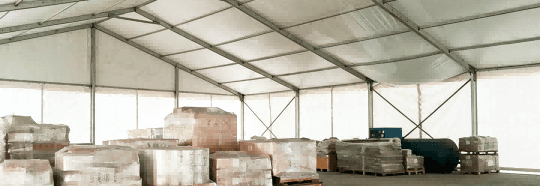
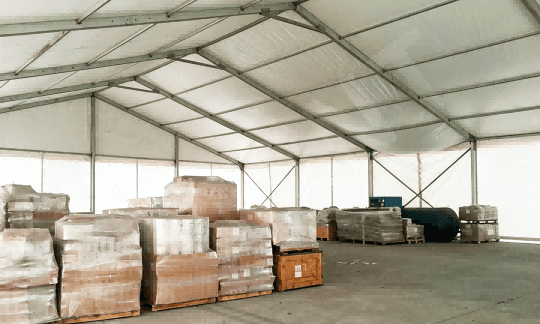
Prefabricated temporary storage tents are designed to address periodic capacity shortages in factories. Requiring minimal foundation work, they can be installed on open ground within factory premises or in unused areas around existing facilities. Their rapid assembly allows for the storage of finished goods in a very short timeframe. Featuring a wide-span, column-free design, these tents provide an expansive and unobstructed interior, well-suited for palletized storage and forklift operations. Furthermore, they can be customized with optional features—such as roll-up doors, translucent roof panels, lighting systems, and fire safety equipment—to ensure full compliance with storage standards for finished products.
Flexible configuration models to balance warehousing pressure across peak and off-peak seasons
During peak seasons, temporary warehouse tents can be erected to accommodate an influx of finished goods; once the order surge subsides, these structures can be quickly dismantled. Their components are relocatable and reusable, ensuring they do not occupy factory land on a permanent basis. Many manufacturing enterprises employ a hybrid model—combining a "fixed primary warehouse" with "temporary tent warehouses"—where the fixed facility holds routine inventory, while the tents handle the additional volume generated during peak periods, allowing for flexible capacity management. This approach balances storage security, operational efficiency (inbound and outbound logistics), and cost control, offering a practical solution for manufacturers to navigate production fluctuations and address shortages in finished-goods storage space.