
6 November 2026 · Tent Ideas · WT tent
Many enterprises encounter a major hurdle during the expansion of temporary storage facilities or staging areas: the construction of the ground surface. For traditional steel-structure warehouses, the preparation process—involving excavation, base layer installation, concrete pouring, and curing—can take weeks, entailing high costs for both materials and labor. When a facility is needed only for short-term inventory storage or to handle seasonal surges, investing heavily in permanent ground surfacing becomes problematic; should the site eventually need to be relocated, such an investment would result in a waste of resources. This leaves many manufacturing and logistics companies in a difficult dilemma.
Pain points in traditional warehouse construction: High threshold for floor hardening
When constructing traditional permanent warehouses, hardening the ground—typically by pouring concrete—is an unavoidable step. This entails significant civil engineering costs, and the subsequent curing period further delays the start of operations. For many enterprises with temporary storage needs—where goods are kept only for a short term—investing in a hardened surface is highly cost-inefficient; once the lease expires, the hardened ground cannot be removed, resulting in a waste of both capital and resources.
Storage Tents: Low foundation requirements, with a variety of anchoring options available
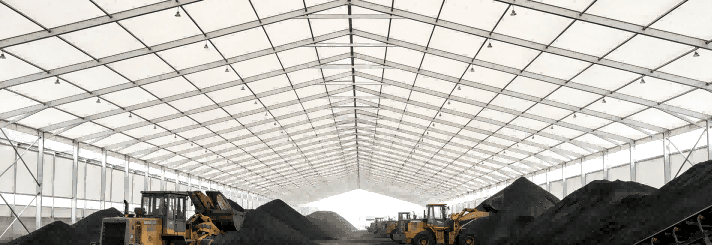
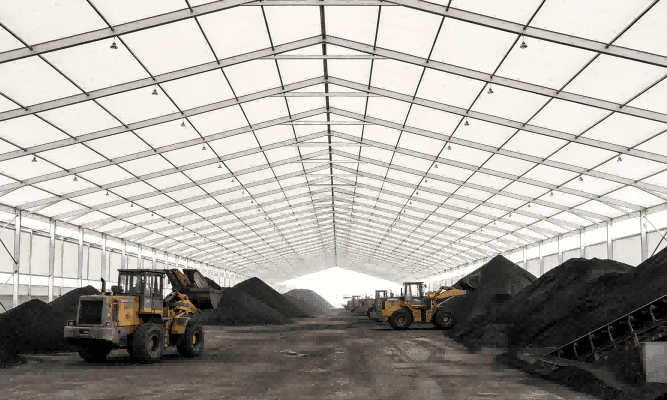
Unlike traditional structures, aluminum-alloy storage tents do not require complex, deep foundations. They are highly adaptable to various site conditions and can be installed directly onto leveled concrete or compacted gravel surfaces—eliminating the need for extensive ground preparation or permanent paving and significantly reducing the scope of civil engineering work.
A range of proven anchoring solutions is available to suit different ground types: expansion bolts can be used for concrete surfaces, while steel stakes are ideal for gravel or soil. For sites where drilling is not feasible, ballast weights can be employed to secure the structure, ensuring the original ground remains completely undisturbed. A professional team can carry out rapid on-site assembly, delivering a functional storage space in a short timeframe—an ideal solution for needs such as managing inventory surges during e-commerce peak seasons, facilitating material transshipment, storing equipment, or providing temporary cargo staging.
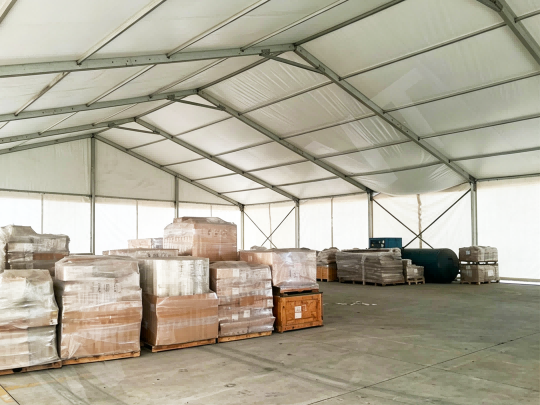
Advantages of prefabricated construction: rapid assembly, and the ability to disassemble and reuse components.
Beyond the minimal foundation requirements, storage tents offer several distinct advantages. Their primary structure consists of a high-strength 6061-T6 aluminum alloy frame, which is both lightweight and structurally stable. Covered with PVC fabric, these tents provide protection against rain, dust, and sun, ensuring that goods remain shielded from the elements. As modular, prefabricated structures, they can be customized in terms of length, width, and height. They feature large spans with no internal support columns, resulting in high space utilization and allowing for the unobstructed movement of forklifts and pallet jacks.
When a business undergoes operational adjustments or needs to relocate, storage tents can be dismantled, transported, and reassembled elsewhere—unlike permanent warehouses, which are tethered to a specific site. They eliminate the need for costly civil construction and long wait times, offering an ideal balance of practicality and flexibility.
For companies with temporary storage needs or requirements for phased capacity expansion, storage tents transcend the constraints of traditional, permanent warehouse construction. With their minimal foundation requirements, versatile anchoring options, rapid deployment, and portability, they lower the barriers to establishing storage facilities—making them a highly cost-effective storage solution.