

4 November 2026 · Tent Ideas · WT tent
During the rainy season, many businesses struggle with water seepage in their warehouses and moisture-related damage to their inventory. Expanding traditional warehouse facilities is costly, while makeshift storage structures often lack adequate waterproofing—leading to issues like moldy cardboard boxes, rusted hardware, and raw materials ruined by dampness. These problems not only result in direct inventory loss but also cause delays in order fulfillment. Prefabricated storage tents have become a popular solution for expanding storage capacity due to their rapid assembly and flexible adaptability. However, successfully navigating the rainy season requires more than just the waterproof properties of the tent fabric itself; it demands a comprehensive, systematic approach.
Many people mistakenly assume that leaks in a tent are solely due to the quality of the fabric. In reality, most risks of water seepage and moisture damage stem from oversights in design or installation. Common issues include insufficient roof slope leading to water pooling, substandard seam-joining techniques, missing gutters or downspouts, moisture rising from the ground, condensation caused by temperature differentials inside the tent, and inadequate sealing around doors, windows, or utility openings. While leaks involve the ingress of external rainwater, moisture issues often stem from internal condensation; because these phenomena have different root causes, they require distinct management strategies.
Roof Drainage: Strengthening the First Line of External Waterproofing Defense
For the fabric, an 850g/㎡–1050g/㎡ PVC knife-coated tarpaulin is preferred. It must be joined using a high-temperature heat-sealing process to prevent water leakage through stitch holes; the material should also feature anti-mold and UV-resistant coatings to extend its service life. In regions with high rainfall, A-frame tents should have a roof pitch of at least 18° to facilitate rapid rainwater runoff. The perimeter of the tent should be equipped with aluminum alloy gutters and downspouts to direct rainwater into external drainage channels, preventing water from flowing back and soaking the foundation. Additionally, waterproof sealing strips and weather-resistant sealant should be ap
plied at profile junctions, around doors and windows, and at points where utility lines pass through, ensuring that all potential leak points are effectively sealed.
Base moisture barrier: blocking the upward migration of ground moisture
Preventing the upward migration of ground moisture is crucial for protecting goods stored at the base level. For long-term storage, it is recommended to use an elevated framework—ideally constructed with aluminum alloy bases—to create an air gap, with goods placed on pallets atop this structure. In temporary or emergency scenarios, a thick PE moisture-proof membrane may be laid down, ensuring that all overlaps are properly sealed. For permanent storage sites, the priority should be to harden the flooring, apply a moisture-proof coating, and ensure the surface is properly graded for drainage. Under no circumstances should the bottom edges of a tarpaulin be placed directly onto water-logged ground, as this will lead to moisture seepage via capillary action.
Ventilation and Humidity Control: Solving the Problem of Internal Condensation and Dripping
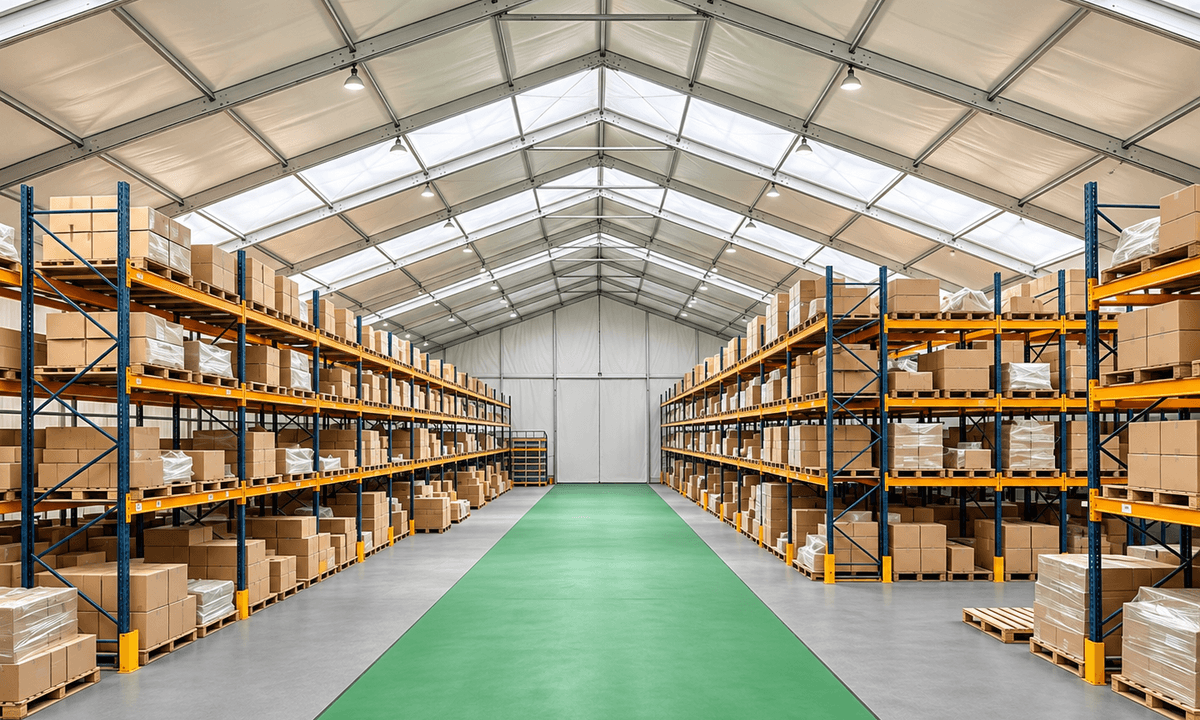
Condensation and dripping inside a tent structure are issues that should not be overlooked. Significant temperature differences between the interior and exterior of an enclosed space can easily cause water vapor to condense on the tent roof. To address this, consider installing waterproof ventilation louvers or industrial exhaust fans to allow for regular air exchange during fair weather. For storage scenarios requiring strict humidity control, add dehumidifiers to maintain stable moisture levels. When stacking goods, ensure there is a gap between the cargo and the tent walls, and leave ventilation aisles between stacks—do not place items directly against the inner surface of the tent fabric. Additionally, equip loading/unloading doors with sealing strips and install rain awnings on the exterior to prevent wind-driven rain from entering the facility.
Regular inspections and maintenance to reduce the risk of cargo damage during the rainy season
Waterproofing and moisture protection also rely on routine operation and maintenance. This includes regularly clearing debris from gutters—especially before and after the rainy season—inspecting tarpaulin seams and sealing strips for signs of aging or cracking, and placing hygrometers inside the storage tents to monitor humidity levels in real time. By tailoring solutions based on storage cycles, cargo types, and site topography, you can fully leverage the advantages of storage tents, effectively mitigate the risk of cargo damage during the rainy season, and ensure stable, reliable storage operations.